
 by
by Introduction
Cyber security is one of the fastest-growing career fields today. If you are a student wondering what you will actually learn in a cyber security course for beginners, this guide will give you a clear idea.
A good cyber security training course is not just about theory—it focuses on practical skills that help you protect systems, networks, and data from cyber attacks.
What is Cyber Security?
Cyber security means protecting computers, networks, and data from unauthorized access, hacking, or damage.
Students joining a cyber security course in Yamuna Vihar or searching for cyber security classes near me usually start with the basics and then move toward advanced topics like ethical hacking and network security.
Why Should Students Learn Cyber Security?
Today, almost everything is online—banking, education, shopping, and communication. This makes cyber security an important skill.
Key Reasons:
- High demand in IT jobs
- Good salary opportunities
- Useful for personal data protection
- Opportunity to work in ethical hacking
That’s why many students choose an ethical hacking course for students to build a strong career.
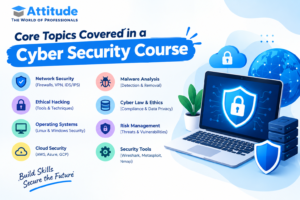
Core Topics Covered in a Cyber Security Course
Let’s understand what you will actually learn step by step:
1. Basics of Cyber Security
This is the starting point for beginners.
You will learn:
- What is hacking and cyber crime
- Types of cyber attacks (phishing, malware, ransomware)
- Basic security concepts
This foundation is important for anyone starting a cyber security course in Yamuna vihar.
2. Networking Fundamentals
Before learning security, you must understand networks.
Topics include:
- IP address and DNS
- How the internet works
- Network devices (router, firewall)
This is often covered in network security training for beginners.
3. Ethical Hacking
One of the most interesting parts of the course.
You will learn:
- How hackers think
- Penetration testing basics
- Finding vulnerabilities in systems
This is why many students prefer an ethical hacking training course as part of their learning.
4. Network Security
In this module, you will learn how to protect networks.
Topics include:
- Firewalls and VPNs
- Intrusion detection systems
- Securing Wi-Fi networks
This is a key part of any cyber security course with practical training.
5. System Security
This focuses on protecting computers and servers.
You will learn:
- Windows and Linux security
- Password protection techniques
- System vulnerabilities
6. Web Security
Websites are common targets for hackers.
Topics include:
- SQL injection
- Cross-site scripting (XSS)
- Website security testing
7. Cyber Laws & Ethics
Cyber security is not just technical—it also involves legal knowledge.
You will learn:
- Cyber laws in India
- Ethical responsibilities
- Legal consequences of hacking
This is an important part of a cyber security certification course in uttam nagar.
8. Practical Training & Tools
A good course always includes hands-on practice.
You will work with tools like:
- Wireshark
- Metasploit
- Kali Linux
This makes learning more effective and job-ready.
Real-Life Example
Imagine you receive a fake email asking for your bank details.
A student trained in cyber security can:
- Identify phishing attempts
- Avoid clicking harmful links
- Protect personal data
This is how practical knowledge from a cyber security training course helps in real life.
Career Opportunities in Cyber Security
After completing a course, students can explore roles like:
- Ethical Hacker
- Security Analyst
- Network Security Engineer
- Cyber Security Consultant
With the right skills, you can build a strong career in this field.

Conclusion
A cyber security course covers everything from basic concepts to advanced practical skills. Whether you are starting with a cyber security course for beginners or exploring an ethical hacking course for students, the learning path is structured and career-focused.
If you want a skill that is future-proof and highly in demand, cyber security is definitely worth learning.Visit us
FAQs
1. Is cyber security easy for beginners?
Yes, most courses start from basics, making it easy for beginners to understand.
2. Do I need coding for cyber security?
Basic knowledge helps, but many topics can be learned without coding initially.
3. What is the duration of a cyber security course?
It usually ranges from 3 to 6 months depending on the level.
4. Is ethical hacking legal?
Yes, ethical hacking is legal when done with permission.