 by
The Internet of Things (IoT) is changing the way people interact with technology. From smartwatches and home security systems to connected cars and industrial machines, IoT allows everyday devices to connect to the internet, collect information, and share data. As this technology continues to grow, learning about it through an IoT course in Uttam Nagar can help students understand how connected devices work and how they are used in real-world situations.
1. What Is the Internet of Things (IoT)?
The Internet of Things refers to a network of physical devices connected to the internet. These devices collect and exchange data using sensors, software, and communication technologies. For example, a smart thermostat can detect room temperature and automatically adjust the air conditioning. Similarly, a fitness band can track steps, heart rate, and sleeping patterns.
Understanding these basic concepts is an important part of an Internet of Things, where beginners can explore how technology connects physical devices with digital systems.
2. How Does IoT Work?
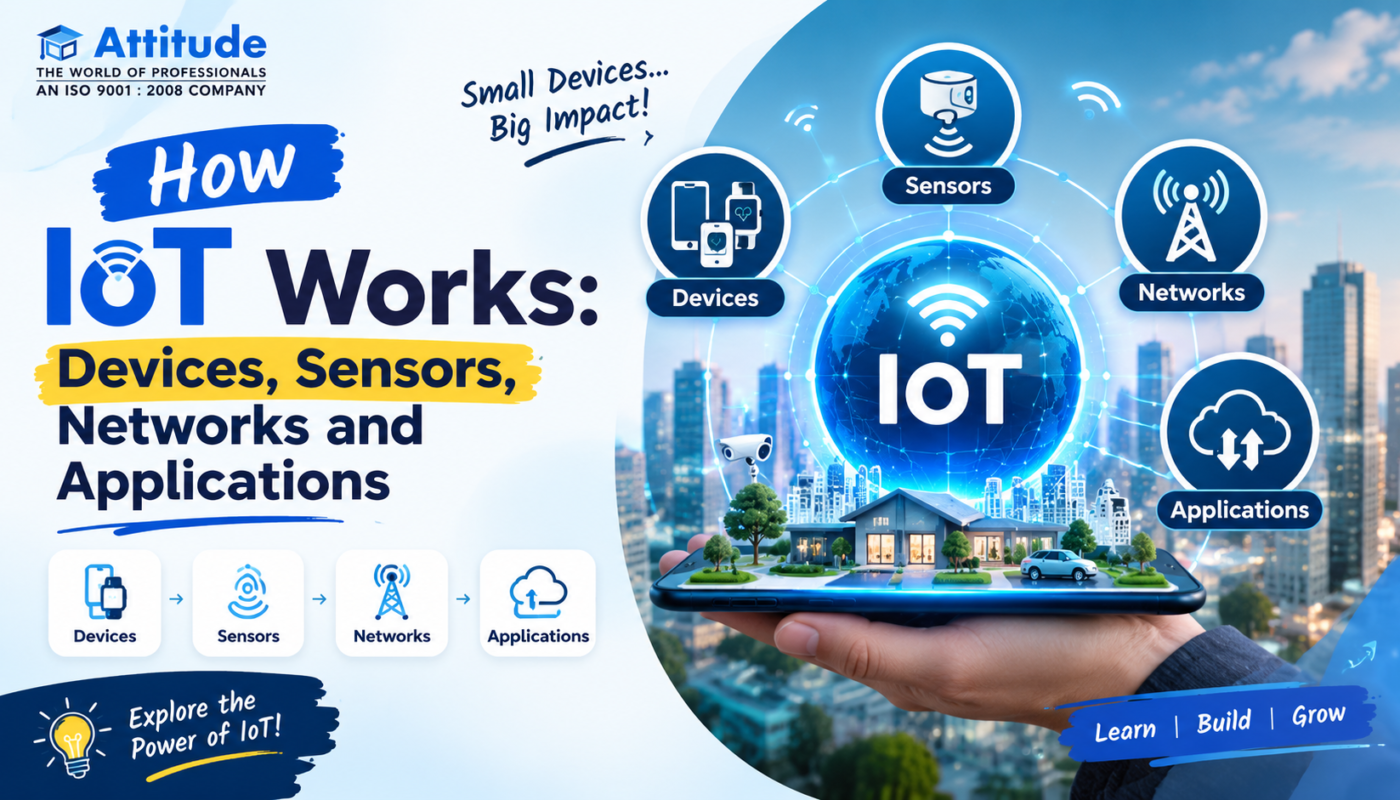
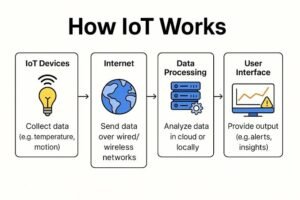
IoT works through a combination of connected devices, sensors, internet connectivity, data processing, and user applications. These components work together to collect information and perform specific actions.
The basic working process includes four important steps:
Step 1: Data Collection
IoT devices use sensors to collect information from their surroundings. Temperature sensors measure heat, motion sensors detect movement, and humidity sensors measure moisture levels.
Step 2: Data Transmission
After collecting information, the device sends the data through a communication network. Technologies such as Wi-Fi, Bluetooth, cellular networks, and Zigbee help devices transfer information.
Step 3: Data Processing
The collected information is processed using cloud platforms, servers, or local systems. The system analyzes the data and determines whether any action is required.
Step 4: Action and User Notification
Finally, the system performs an action or sends information to the user. For example, a smart security camera can send an alert to your phone when it detects unexpected movement.
Students exploring an IoT training institute Uttam Nagar can benefit from learning this complete process through practical demonstrations and simple connected-device projects.
3. Important Components of an IoT System
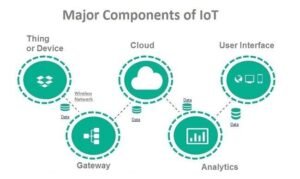
An IoT system depends on several components that work together to make connected technology function properly.
- Sensors and Devices
Sensors collect information from the physical environment. Common examples include temperature sensors, motion sensors, light sensors, pressure sensors, and humidity sensors.
- Connectivity
Connectivity allows IoT devices to communicate with other devices, applications, or cloud platforms. Wi-Fi, Bluetooth, mobile networks, and Zigbee are commonly used communication technologies.
- Data Processing
Once information reaches a computer system or cloud platform, it is analyzed to identify patterns and make decisions. This helps IoT systems respond automatically to different situations.
- User Interface
A user interface allows people to monitor and control connected devices. Mobile apps, websites, and computer dashboards are common examples.
- Actuators
Actuators perform physical actions based on instructions received from the system. For example, a smart irrigation system can automatically switch on a water pump when the soil becomes dry.
When comparing the Best IoT course Uttam Nagar, students should look for programs that explain these components and provide opportunities to work with actual sensors, circuits, and connected devices.
4. Different Types of Sensors Used in IoT
Sensors are one of the most important parts of IoT technology because they help devices understand their surroundings.
Some commonly used sensors include:
- Temperature Sensor: Measures the temperature of an environment or object.
- Motion Sensor: Detects movement in a particular area.
- Humidity Sensor: Measures moisture levels in the air.
- Light Sensor: Detects the intensity of light.
- Pressure Sensor: Measures pressure in gases or liquids.
- Ultrasonic Sensor: Uses sound waves to measure distance.
Students interested in combining electronics with automation can explore IoT and robotics training Uttam Nagar to understand how sensors work with motors, controllers, and other hardware components.
5. Common Communication Technologies in IoT
IoT devices need communication technologies to exchange information. The choice of technology depends on distance, speed, power consumption, and the type of application.
Some popular IoT communication technologies are:
- Wi-Fi: Commonly used in smart homes, cameras, and internet-connected appliances.
- Bluetooth: Useful for short-distance communication between devices.
- Zigbee: Often used in smart lighting and home automation systems.
- LoRaWAN: Suitable for long-range communication with low power consumption.
- Cellular Networks: Used in connected vehicles, tracking systems, and remote monitoring.
Learning these technologies is also useful for students considering an IoT certification course Uttam Nagar, as they provide a foundation for understanding connected systems and their practical applications.
6. Real-Life Applications of IoT
IoT is used in many industries to improve productivity, save time, and automate everyday activities.
Smart Homes: Smart lights, security cameras, smart locks, and automated appliances can be controlled through mobile applications.
Healthcare: Connected medical devices can monitor health measurements and share information with healthcare professionals.
Agriculture: Smart farming systems use soil moisture and temperature sensors to monitor crops and manage irrigation.
Transportation: GPS tracking, connected vehicles, and traffic monitoring systems help improve transportation management.
Manufacturing: Industrial IoT helps companies monitor machines, track production, and identify possible equipment problems.
Education: IoT-based smart classrooms can use connected devices to improve classroom management and learning experiences.
Students looking for an IoT Training / institute Yamuna Vihar can explore how these applications are developed and understand how IoT is used across different industries.
7. IoT Projects Students Can Build
Practical projects are an effective way to understand how IoT works. Beginners can start with simple projects before moving to advanced applications.
Here are some project ideas:
- Smart Home Automation: Control lights and electrical appliances using a mobile application.
- Automatic Plant Watering System: Use a soil moisture sensor to control water supply.
- Smart Dustbin: Use an ultrasonic sensor to detect the dustbin’s fill level.
- Weather Monitoring System: Collect temperature and humidity data using sensors.
- Smart Parking System: Detect available parking spaces using sensors.
- Motion Detection Security System: Detect movement and send alerts to a connected device.
Working on these projects can help students gain practical experience. An IoT training institute Yamuna Vihar that includes project-based learning can help beginners understand the connection between hardware, software, and automation.
8. Skills Required to Learn IoT
Students interested in IoT should develop a combination of technical and problem-solving skills.
Important skills include:
- Basic electronics and circuit understanding
- Programming languages such as Python and C/C++
- Knowledge of Arduino and ESP32
- Understanding of sensors and microcontrollers
- Basic networking and internet concepts
- Cloud computing fundamentals
- Problem-solving and project development
Before selecting the Best IoT course Yamuna Vihar, students should check whether the learning program covers these important skills along with practical exercises.
9. How to Start Learning IoT?
Beginners can start by understanding basic electronics, programming, and networking concepts. After learning the fundamentals, they can practice using Arduino or ESP32 boards and different types of sensors.
Building small projects is especially useful because it allows students to apply theoretical knowledge to practical situations. They can gradually explore advanced topics such as cloud connectivity, automation, and smart device development.
Students who want to understand both connected devices and automated machines can consider IoT and robotics training Yamuna Vihar as a learning option. Those looking for structured skill development can also explore an IoT certification Yamuna Vihar program.
For learners who prefer classroom-based guidance, IoT classes in Yamuna Vihar can provide a starting point to understand sensors, programming, networking, and practical IoT applications.
Conclusion
The Internet of Things is making everyday devices smarter and helping industries improve their operations through automation and real-time data. From smart homes to healthcare and agriculture, IoT has applications across many fields.
For students, learning IoT provides an opportunity to understand sensors, programming, networking, and practical project development. Starting with basic concepts and gradually building real-world projects can help develop a strong foundation in this technology.Visit us