 by
by Digital marketing has become an important career option for students because businesses now depend heavily on websites, search engines, social media, online advertising, and content. But learning only the theory of digital marketing is not enough. Students also need to know how to use practical tools that are commonly used to research, create, measure, and improve digital campaigns.
From SEO and content creation to social media and paid advertising, different tools help marketers complete their work faster and make better decisions. If you are planning to build a career in this field, learning the right tools can give you a useful practical foundation.
Why Should Students Learn Digital Marketing Tools?
Digital marketing involves many different activities. A marketer may need to find keywords in the morning, create social media content later, check website traffic, and analyse an advertising campaign by the end of the day.
Tools make these tasks easier.
They help students:
- Research audiences and keywords
- Analyse website performance
- Create social media content
- Track campaign results
- Understand customer behaviour
- Manage online advertising
- Improve SEO performance
More importantly, practical tool knowledge helps students understand how digital marketing works outside the classroom.

1. Google Analytics for Website Analysis
Google Analytics is one of the most useful tools for understanding website visitors.
Students can use it to learn:
- How many people visit a website
- Where visitors come from
- Which pages receive more attention
- How users interact with a website
- Which channels generate traffic
Learning website analytics can be especially useful for students preparing for SEO, content marketing, or performance marketing roles.
2. Google Search Console for SEO
Google Search Console helps marketers understand how a website performs in Google Search.
Students can use it to check:
- Search queries
- Website impressions
- Clicks
- Average search position
- Indexing issues
- Page performance
Anyone interested in an SEO Training Institute in Yamuna Vihar should understand how Search Console supports day-to-day SEO work.
It also helps beginners connect SEO theory with actual search performance.
3. Keyword Research Tools
Keywords are an important part of SEO. Students should learn how to discover what people are searching for before creating content.
Keyword research tools can help identify:
- Search terms
- Related keywords
- Search trends
- Keyword competition
- Content opportunities
This skill is useful for students learning SEO through an SEO Digital Marketing Training Course in Yamuna Vihar because keyword research is used in blogs, website pages, product descriptions, and other content.
4. Canva for Content Creation
Digital marketing is not only about search engines. Visual content is also important.
Canva allows beginners to create:
- Social media posts
- Stories
- Presentations
- Advertisements
- Infographics
- Promotional graphics
Students do not need advanced graphic design knowledge to start creating basic marketing visuals. Learning Canva can therefore be a useful addition to a practical digital marketing skill set.
5. Meta Business Suite for Social Media
Students interested in social media marketing should understand how Meta’s business tools work.
Meta Business Suite can help marketers manage Facebook and Instagram activities, including content publishing, scheduling, messages, and performance analysis.
This makes it useful for anyone preparing for social media or digital marketing roles.
Students taking Digital Marketing Classes in Uttam Nagar can practise creating and scheduling sample campaigns to understand how social media management works.
6. Google Ads for Paid Marketing
Google Ads is another important platform for students who want to understand paid advertising.
Students can learn concepts such as:
- Search campaigns
- Keywords
- Ad groups
- Ad copy
- Bidding
- Conversion tracking
- Campaign performance
Understanding these concepts can help students move beyond basic digital marketing knowledge and explore performance-focused roles.
7. SEO Tools for Competitor Research
SEO professionals regularly analyse competitors to understand their content, keywords, backlinks, and search visibility.
Tools such as Semrush, Ahrefs, and similar SEO platforms can help with:
- Competitor research
- Keyword analysis
- Backlink research
- Content ideas
- Website audits
Students don’t need to master every feature immediately. Starting with keyword research and competitor analysis is enough to build a strong foundation.
8. AI Tools for Digital Marketing
Artificial Intelligence is becoming increasingly useful in digital marketing.
Students can explore AI tools for:
- Content ideas
- Research
- Copywriting assistance
- Content planning
- Data summaries
- Brainstorming
- Basic automation
However, students should remember that AI-generated output still needs human checking. Good marketers know how to combine AI assistance with creativity, strategy, fact-checking, and audience understanding.
How Can Students Practise These Tools?
The best way to learn digital marketing tools is through small projects.
For example, a student can:
- Create a sample website or blog.
- Research keywords for a topic.
- Write an SEO-friendly article.
- Design social media posts using Canva.
- Create a sample Google Ads campaign.
- Track website performance using analytics.
- Prepare a simple monthly performance report.
This type of practice gives students something more valuable than simply knowing tool names—it gives them experience with actual marketing workflows.
What Skills Should Students Learn Alongside These Tools?
Tools are useful, but they should be combined with fundamental marketing skills.
Students should also learn:
- SEO
- Content Marketing
- Social Media Marketing
- Paid Advertising
- Keyword Research
- Analytics
- Copywriting
- Basic Design
- Audience Research
Students searching for Digital Marketing Training in Yamuna Vihar or Digital Marketing Coaching in Uttam Nagar should therefore look for learning that combines concepts with practical tool usage.
Where Can These Skills Lead?
Once students become comfortable with digital marketing tools, they can explore roles such as:
- SEO Executive
- Digital Marketing Executive
- Social Media Executive
- Content Marketing Executive
- PPC Executive
- Performance Marketing Executive
- Digital Marketing Analyst
For beginners, an SEO Digital Marketing Course in Yamuna Vihar can provide a structured starting point for understanding these areas.
Similarly, students searching for Digital Marketing Coaching Institute in Uttam Nagar can focus on programs that provide practical exposure instead of only theoretical lessons.
Final Thoughts
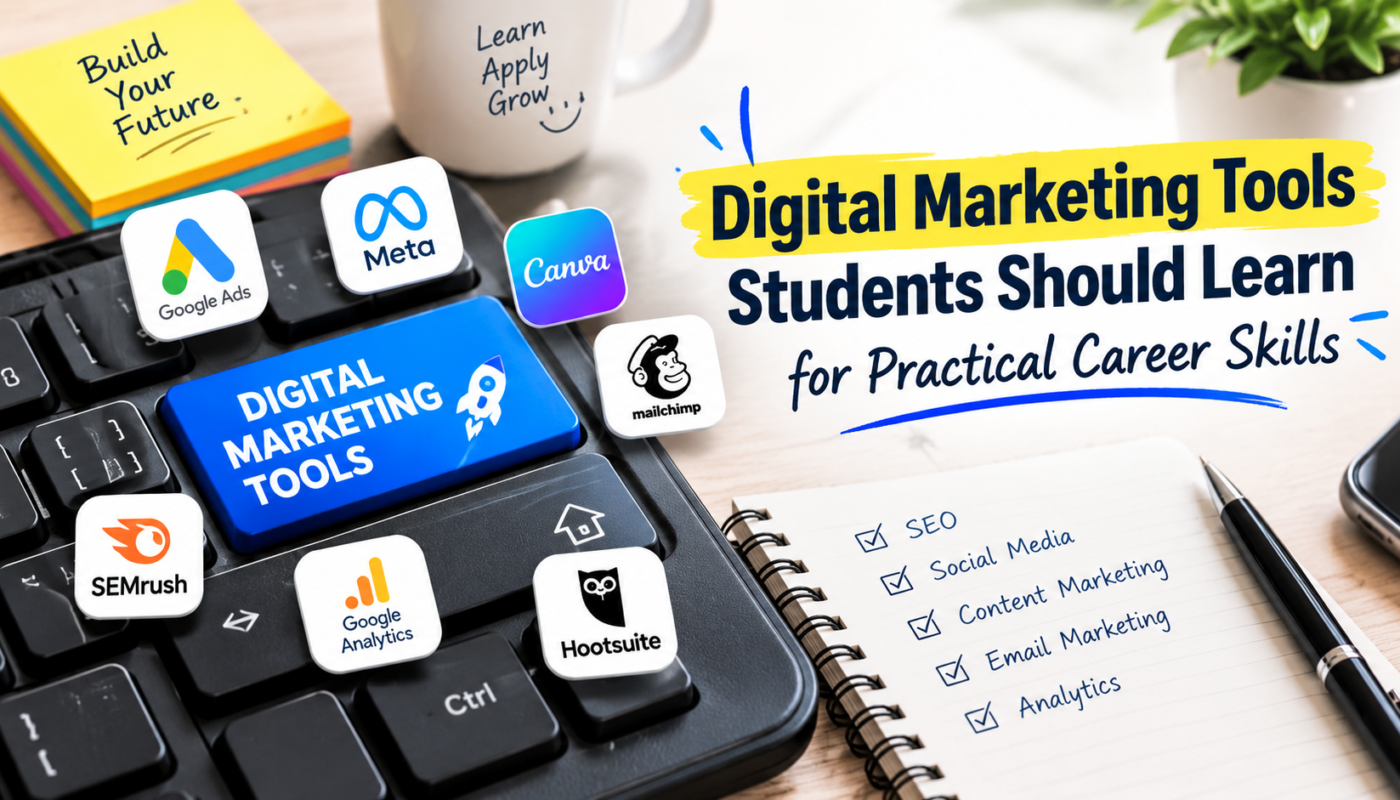
Digital marketing tools are an important part of developing practical career skills. Students do not need to learn every platform at once. A better approach is to start with essential tools such as Google Analytics, Search Console, keyword research platforms, Canva, Meta Business Suite, Google Ads, and AI tools.
As students practise these tools through real or sample projects, they can gradually develop confidence and understand how different areas of digital marketing work together.
The goal should not simply be to collect certificates or learn tool names. The real advantage comes from knowing when to use a tool, how to interpret its results, and how to turn that information into a useful marketing decision.