 by
by INTRODUCTION
When you visit a website, you usually notice the things you can see—buttons, images, menus, forms, and pages. But have you ever thought about what happens after you click a button?
For example, you enter your email and password and click Login. Within seconds, the website checks your details and either opens your account or shows an error. This simple action involves two major parts of web development: the frontend and backend.
For anyone starting a Best Full Stack Development Course for Beginners, understanding how these two parts work together is important. Once you understand their roles, the structure of a web application becomes much easier to follow.
What Is the Frontend?
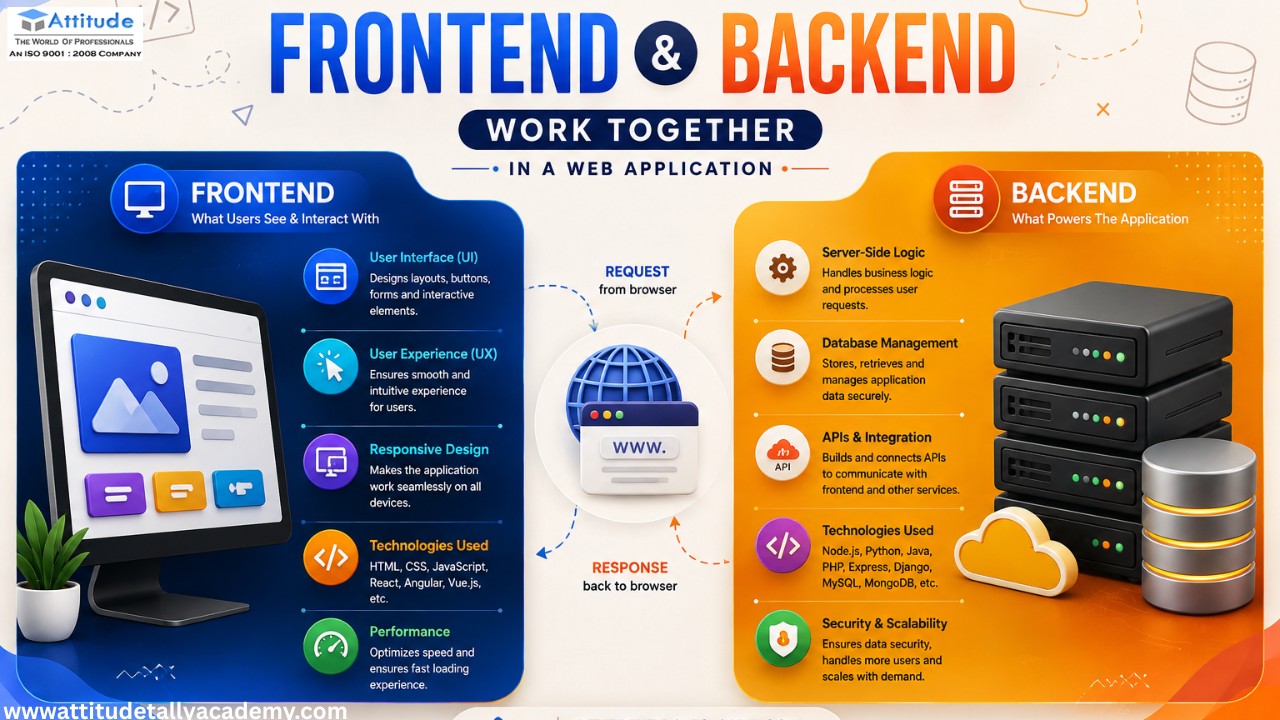
The frontend is the part of a website that you can see and interact with. It is responsible for creating the experience that users have when they visit an application.
A login page is a simple example. The input boxes, login button, headings, colors, and layout are all part of the frontend.
HTML creates the structure of the page, CSS makes it look presentable, and JavaScript allows the page to respond to user actions. Modern websites may also use frameworks and libraries to make applications more interactive.
However, the frontend cannot do all the work by itself. It needs the backend whenever it has to process information or work with stored data.
What Is the Backend?
The backend works behind the scenes. Users do not normally see it, but it is responsible for much of the actual processing that makes an application useful.
Take the same login example. When you enter your details, the frontend sends them to the backend. The backend checks those details, communicates with the required data, and decides what should happen next.
If everything is correct, it can send a successful response. If the information is incorrect, it can return a response that tells the frontend to show an error.
This is one of the basic ideas students learn when attending Full Stack Development Classes in Bhajanpura.
How Do They Work Together?
The easiest way to understand frontend-backend communication is to follow a real example.
Imagine that you are using a website and want to see your profile.
First, you click My Profile. The frontend sends a request to the backend. The backend receives the request and checks what information is needed. It may then request the profile information from the database.
Once the backend gets the required information, it sends a response back to the frontend. The frontend takes that information and displays your profile on the screen.
The process looks something like this:
User → Frontend → Backend → Database → Backend → Frontend → User
All of this can happen very quickly, which is why the user often sees only the final result.
Where Do APIs Fit In?
APIs help the frontend and backend communicate.
Think of an API as a messenger between the two sides. When the frontend needs something from the backend, it sends a request through an API. The backend processes the request and sends the result back.
For example, when a user submits a registration form, the frontend can send the information to the backend through an API. The backend can check the information, save it where required, and return a response.
This is why API understanding is an important part of a Full Stack Web Development Course with Live Projects. Students can see how a webpage becomes connected to actual application functionality.
What Is the Role of a Database?
A database stores information that an application needs to use later.
Think about an online learning platform. It may need to remember student names, login details, course information, registrations, and other records.
The backend usually handles communication with the database. The frontend requests information through the application, while the backend manages the process of retrieving or changing that information.
This separation also makes it easier to control how data is accessed and processed.
Different Full Stack Technology Options
Full stack development can be learned through different technology combinations.
A MERN Stack Full Stack Development Course focuses on MongoDB, Express.js, React, and Node.js. It is one approach where JavaScript-based technologies are used across major parts of application development.
A Java Full Stack Development Course combines frontend development with Java-based backend technologies.
Students interested in Python can explore a Python Full Stack Development Course, where Python is used for backend development alongside frontend technologies.
The technologies may change, but the basic concept remains the same: the frontend and backend need to communicate smoothly.
Why Should Students Learn Both?
Learning only one side of development can give you an incomplete picture of how an application works.
Suppose you know how to create a beautiful webpage. That is useful, but what happens when the webpage needs to save user information, display database records, or process a form?
This is where backend knowledge becomes important.
Learning both sides allows students to understand the complete journey of information—from the user’s action to the server and back to the screen.
Students considering a Full Stack Development Course in Yamuna Vihar should therefore look for a learning approach that explains how these different parts connect rather than treating each topic as completely separate.
Practice Makes the Difference
Full stack development becomes easier when students start building small applications.
A beginner might create a registration page first. Later, they can connect it to an API, add a database, create login functionality, and build a dashboard.
With each project, the relationship between frontend and backend becomes clearer.
Students comparing options for the Best Full Stack Developer Training Institute in Uttam Nagar should consider whether the course includes practical project work and explains concepts through actual application development.
The same applies to students exploring Full Stack Development Training in Vikaspuri or a Full Stack Development Institute in Tilak Nagar. Practical exposure can make a big difference when learning development.
Moving Beyond the Basics
Once students are comfortable with frontend and backend fundamentals, they can move toward more advanced concepts such as authentication, database management, API development, testing, security, and deployment.
An Advanced Full Stack Developer Certification Course can be useful for learners who want to continue developing their skills after understanding the basics.
Students who are preparing for their first development role may also look at a Full Stack Development Course with Placement as part of their career preparation.
Final Thoughts
Frontend and backend are simply two sides of the same web application.
The frontend gives users something to see and interact with. The backend handles the work that happens behind the screen. APIs allow the two sides to communicate, while databases store the information the application needs.
Once you understand this connection, full stack development starts making much more sense. Instead of seeing HTML, JavaScript, databases, APIs, and backend technologies as separate topics, you begin to understand how they come together to build something people can actually use. Visit us