
 by
by Introduction
Accounting is one of the most important parts of any business. It helps in recording financial transactions, managing expenses, and understanding profits. Today, accounting is done in two main ways: manual accounting and computerized accounting. Understanding the difference between both is very important for students who want to build a career in finance or enroll in an e-accounting course.
What is Manual Accounting?
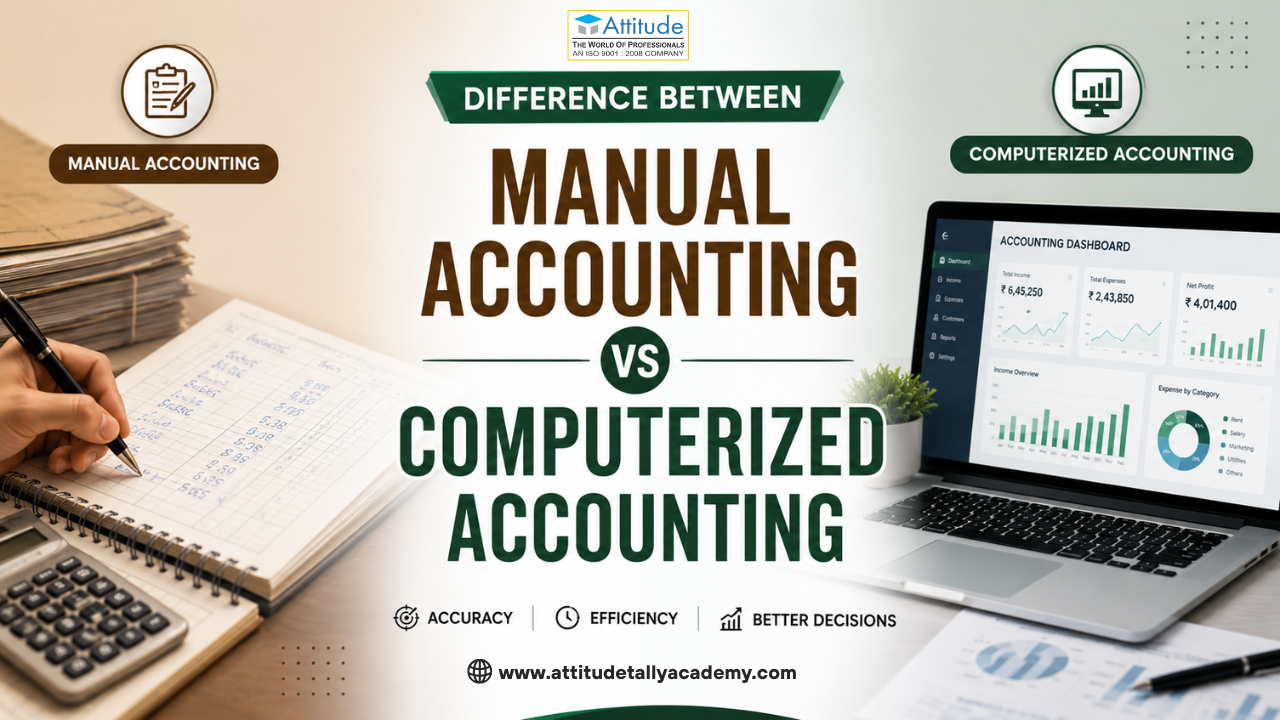
Manual accounting is the traditional way of recording financial data using books, registers, and paper-based systems. In this method, every transaction is written by hand.
Key points:
- Uses physical books and registers
- Time-consuming process
- Higher chances of human error
- Suitable for very small businesses
Students learning in an e-Accounting Training Institute in Yamuna Vihar first understand manual accounting to build a strong foundation.
What is Computerized Accounting?
Computerized accounting uses software to record, manage, and analyze financial data. It is faster, more accurate, and widely used in modern businesses.
Key points:
- Uses accounting software like Tally and Excel
- Fast and accurate results
- Easy data storage and retrieval
- Suitable for all business sizes
Students enrolled in an e-Accounting Training Institute in Uttam Nagar or e-Accounting Classes in Uttam Nagar get practical exposure to computerized systems.
Key Differences Between Manual and Computerized Accounting
Understanding the difference helps students choose the right learning path.
1. Speed
Manual accounting is slow because everything is written by hand. Computerized accounting processes data quickly with software.
2. Accuracy
Manual accounting has a higher risk of errors, while computerized systems reduce mistakes significantly.
3. Storage
In manual accounting, records are stored in books. In computerized accounting, data is stored digitally and can be accessed anytime.
4. Cost
Manual accounting is cheaper initially but requires more effort. Computerized accounting may require software investment but saves time and effort in the long run.
Practical Skills Students Learn
When students join structured training, they learn both theoretical and practical skills such as:
- Ledger creation and maintenance
- Invoice generation
- Financial reporting
- GST and taxation basics
- Software handling skills
Some institutes also offer e-taxation training in Yamuna Vihar and e-filing training in Uttam Nagar, which are highly useful for job readiness.
Benefits of Computerized Accounting
Computerized accounting has many advantages over manual methods:
Key benefits:
- Saves time and effort
- Reduces human errors
- Improves data security
- Helps in faster decision-making
- Easy report generation
Students who complete an e-Accounting Coaching Training In Yamuna Vihar or e-Accounting Coaching Training In Uttam Nagar gain these practical benefits during training.
Career Opportunities in Accounting Field
After learning accounting skills, students can explore various career options such as:
- Accountant
- Accounts Executive
- Tax Consultant
- GST Practitioner
- Finance Assistant
With proper training from an e-Accounting Training Centre in Yamuna Vihar or e-Accounting Training Centre in Uttam Nagar, students can easily start their professional journey.
Final Thoughts
Both manual and computerized accounting are important to understand, but in today’s digital world, computerized accounting is far more useful and in demand. It helps businesses save time, reduce errors, and manage finances more efficiently.
For students who want a strong career in finance, joining a structured program like an e-accounting course is a smart step. With the right training, you can build strong skills and open doors to many job opportunities.visit us
