
 by
by If you’ve ever flipped through a fashion magazine and wondered how those elegant outfit illustrations came to life — that process begins with a sketch. Fashion sketching is the first language every dress designer learns to speak. Before fabric is cut, before a stitch is placed, the entire vision lives on paper.
For students stepping into the world of fashion, sketching is not just an art — it’s a professional tool. And the earlier you develop this skill, the stronger your foundation becomes.
What Is Fashion Sketching and Why Does It Matter?
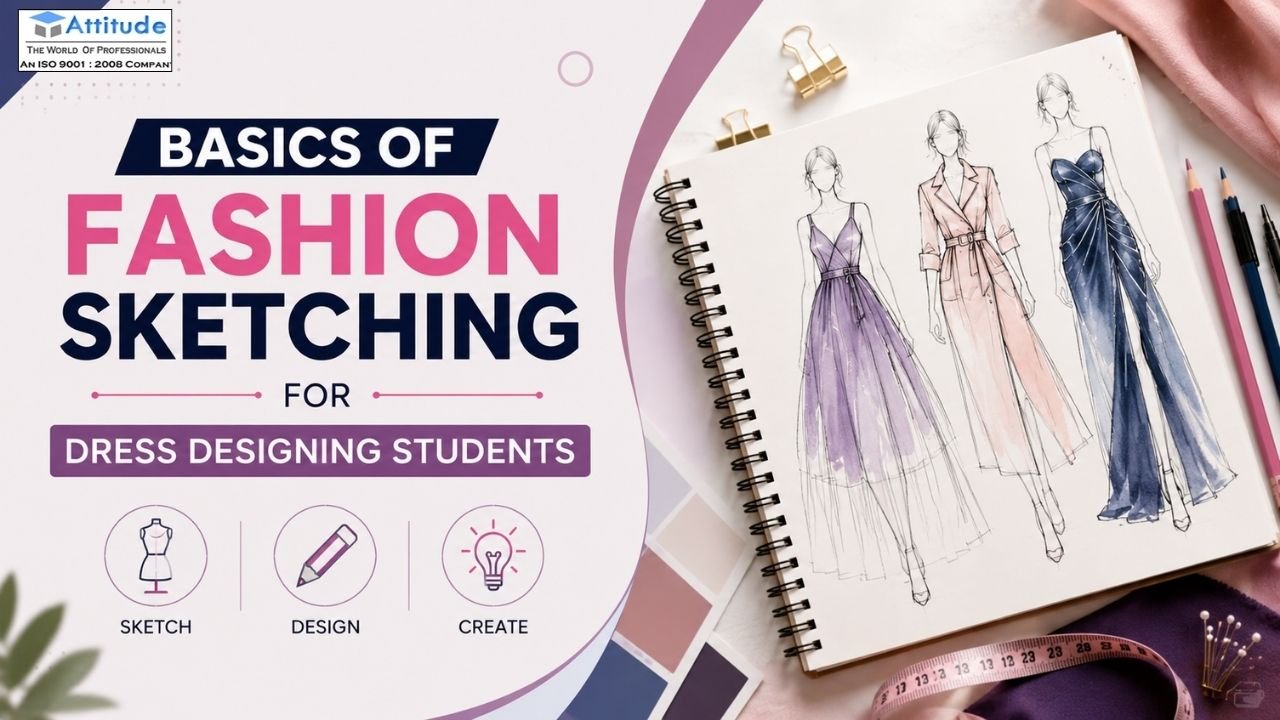
Fashion sketching is the process of drawing clothing designs on a human figure — called a croquis — to visually communicate how a garment will look when worn. It helps designers plan proportions, experiment with silhouettes, and present ideas to clients or production teams before a single piece of cloth is involved.
Think of it as the blueprint stage of dress designing. Just like an architect draws a building before construction begins, a designer sketches before they sew.
For anyone enrolled in or considering dress designing classes in Yamuna Vihar, developing sketching skills early on creates a major advantage — it sharpens your eye for detail and gives you a personal design language.
Starting with the Croquis: Your Design Canvas
The croquis is a simplified human figure used as a template for fashion illustrations. It’s typically elongated — around 9 to 10 heads tall — to give clothing an elegant, exaggerated proportion that highlights the design rather than realistic anatomy.
How to begin:
- Practice drawing the croquis in different poses — front-facing, three-quarter view, and side profile
- Keep the figure light and minimal so your clothing details stand out
- Focus on posture — a confident stance makes any design look more dynamic
Most dress designing training programs introduce students to croquis drawing in the first few weeks, as it becomes the recurring base for every design they create going forward.
Understanding Silhouette Before Details
One of the biggest mistakes beginners make is rushing into details — buttons, patterns, embroidery — before they’ve nailed the silhouette. The silhouette is the overall shape and outline of the garment, and it’s what catches the eye first.
Common silhouettes every dress designing student should know:
- A-Line — fitted at the top, flared at the bottom
- Bodycon — close-fitting throughout
- Empire Waist — defined seam just below the bust
- Flared/Peplum — structured volume at specific points
- Straight/Column — minimal flare, clean lines
Once you understand how different silhouettes behave on the body, your sketching becomes far more intentional. Students attending a dress designing training institute in Yamuna Vihar typically spend dedicated sessions exploring these shapes through repeated sketching exercises.
Tools You Actually Need to Start
You don’t need expensive equipment to begin. Here’s what works well for beginners:
- Pencils (H and HB grades) — for light base sketches and corrections
- Fine-tip black markers or pens — for clean outlines
- Copic markers or watercolors — for adding fabric texture and color
- A sketchbook with smooth paper — so your markers don’t bleed through
- A croquis template sheet — until you’re confident drawing the figure freehand
Many fashion designing classes in Yamuna Vihar provide starter kits or material lists during enrollment so students aren’t overwhelmed choosing supplies on their own.
Fabric Rendering: Bringing Texture to Life
Once the silhouette is drawn, the next skill to develop is fabric rendering — the technique of making your sketch look like it’s made of a specific material.
- Silk — smooth, with soft light reflections and clean folds
- Denim — stiff, angular folds with visible texture
- Chiffon — light, flowing, with delicate layering
- Cotton — structured but soft, with natural wrinkles
Each fabric has its own behaviour on the body, and learning to sketch these differences accurately is what separates a beginner from a skilled fashion illustrator. This is a core module in most dress designing courses in Yamuna Vihar, where students practice rendering different fabrics across various garment types.
Colour Theory in Fashion Sketching
Colour is emotion. In fashion design, choosing the right palette can make or break a collection. As a student, start with the basics:
- Complementary colours create bold, high-contrast outfits
- Analogous palettes feel harmonious and cohesive
- Neutral bases with pop accents are endlessly versatile
Practice filling your croquis sketches with different colour combinations. Over time, you’ll develop an instinct for what works together and what clashes — a skill that’s as important in fashion as pattern or cut.
Digital Sketching: The Modern Add-On
While hand sketching remains the foundation, the industry is increasingly moving toward digital tools. Applications like Procreate, Adobe Illustrator, and CorelDRAW allow designers to sketch, color, and present collections in a polished, professional format.
If you’re exploring a fashion designing training institute in Yamuna Vihar or a dress designing training institute in Yamuna Vihar, look for one that incorporates digital sketching alongside traditional hand illustration. That combination makes you industry-ready from day one.
Consistency Is the Real Skill
Fashion sketching is not about being a perfect artist. It’s about communicating your ideas clearly and developing a personal visual style. Some of the most celebrated designers in the world have simple, rough sketches — but they’re consistent, expressive, and purposeful.
The only way to improve is to sketch every single day. Fill pages. Experiment with silhouettes. Try new fabric textures. Revisit old sketches and redo them with fresh eyes.
If you’re serious about building a career in dress designing, the sketchbook in your bag is just as important as any machine or software you’ll eventually learn. Start there, and everything else follows naturally.visit us